
At a Glance
- Keeping pear psylla populations low during the dormant season is critical.
- Correct identification and timing pesticide applications to the pest’s life stage are key.
- Overwintering adults return to orchards in early March and begin laying eggs on/near buds.
- Scout now (conventional and organic) and prepare for dormant oil applications.
- Monitoring is year-round; use beating board and shoot/spur sampling methods.
- Cultural, chemical (dormant–pink bud), and mechanical tools all play a role.
Overview & Early-Season Focus
Controlling and maintaining low pear psylla populations during the dormant season is essential for managing this damaging pest. Correct identification is critical, as is applying pesticides at the correct time for the life stage you are targeting.
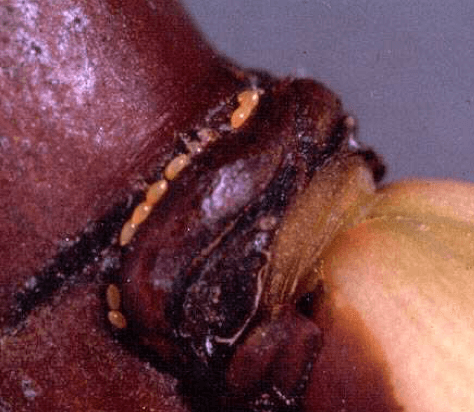
Pear psylla overwinter as adults on nearby trees and shrubs. They return to pear orchards in early March to lay eggs on or near buds. At this time, both conventional and organic growers should be scouting and preparing for dormant oil applications.
Identification: Eggs, Nymphs, Adults
Eggs |
Nymphs |
Adults |
|
|
|
|

|
Monitoring & Sampling (Year-Round)
Monitoring both pest and beneficial populations is an important part of IPM. Knowing which beneficials are present helps you choose a pesticide that minimizes harm to these organisms. The BC Tree Fruit Production Guide lists the relative toxicity of common control products to beneficial insects.
Monitoring for pear psylla occurs all year, with techniques adapted to the dormant season, bloom, the growing season, and harvest. Two methods described here:
Beating Board Samples
- Make three beats of a branch with a beating stick over a board covered with light-coloured fabric.
- Use a hand lens or magnifier to detect insects on the board.
Shoot & Spur Samples (Dormant Season)
- Take two shoots per tree (one from the top, one from eye level).
- Each shoot should include a fruiting spur.
- Sample at least five trees per four acres.
- Examine shoots for pear psylla eggs.
Management Tools
Cultural
- Avoid aggressive pruning that drives excessive vigour.
- Remove water sprouts (the only source of succulent leaves in June for pear psylla).
- Use appropriate nitrogen applications; overapplication extends growth and delays hardening off.
Chemical (Dormant to Pink Bud Stage)
- Apply a dormant spray up to pink bud if one or more adults per limb tap are collected in spring.
- Dormant oil in early March discourages egg-laying for about six weeks (until leaves emerge).
- Adding lime-sulfur to early dormant oil can also suppress pear rust mite and pear leaf blister mite.
- Resample at 7–10 days after oil; if at least one adult per limb tap persists, apply a second half-rate oil.
- Refer to Guardsman Dormant Oil, PureSpray Green Oil, and Lime-Sulfur labels for rates and application info.
- Organic growers should confirm product acceptability with their Certification Bodies.
Mechanical
- Reflective plastic mulch can aid early-season control (research by Louis Nottingham and Betsy Beers, WSU).
- Remove the mulch partway through the season.
Learn More (Video)
Watch the BC DAS Pear Psylla video on YouTube to connect field knowledge with the online DAS program: